“Get your eight hours” is one of the most repeated pieces of health advice there is and it’s not quite right for everyone. The truth is that how much sleep you need changes throughout your life, and even two adults of the same age can have genuinely different needs.
So how much sleep should you be getting? Below is the recommended amount of sleep by age, based on the widely used National Sleep Foundation guidelines, plus how to figure out your own ideal number. Hours only tell part of the story; this stages walkthrough is why eight hours can still feel thin. If you have been running short, the sleep-debt guide covers what you can and cannot pay back. For a wider look at recommended ranges, see published guidance.
Recommended Hours of Sleep by Age
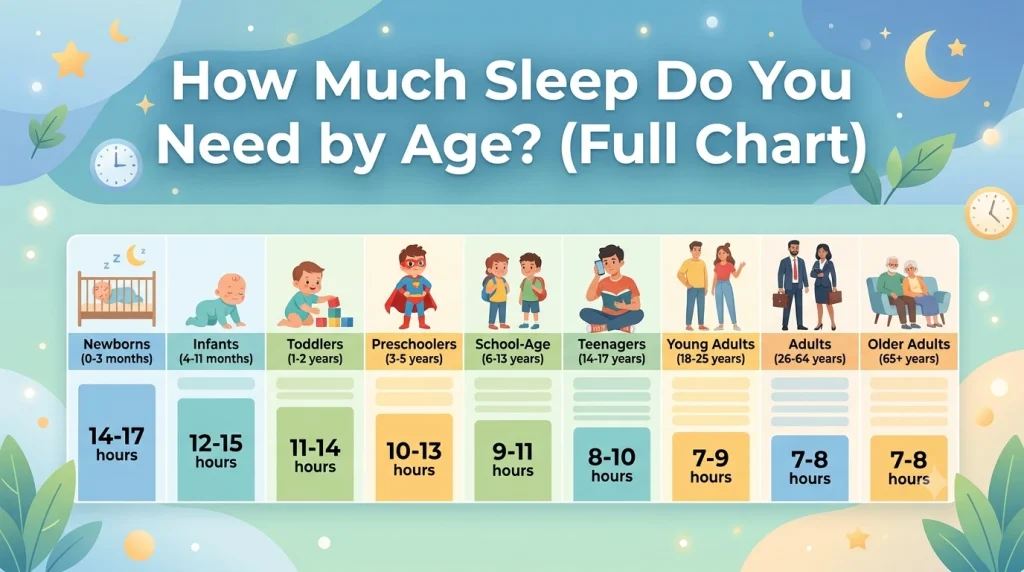
After reviewing hundreds of studies, the National Sleep Foundation published the following nightly sleep recommendations for each age group:
| Age Group | Age Range | Recommended Sleep |
|---|---|---|
| Newborn | 0–3 months | 14–17 hours |
| Infant | 4–11 months | 12–15 hours |
| Toddler | 1–2 years | 11–14 hours |
| Preschooler | 3–5 years | 10–13 hours |
| School-age Child | 6–13 years | 9–11 hours |
| Teenager | 14–17 years | 8–10 hours |
| Young Adult | 18–25 years | 7–9 hours |
| Adult | 26–64 years | 7–9 hours |
| Older Adult | 65+ years | 7–8 hours |
(For babies and children, these totals include daytime naps.)
It’s a Range, Not a Rule
Notice that every recommendation is a range. That’s deliberate. Some people feel fantastic on the lower end, while others genuinely need every minute of the upper limit — and an hour either side can still be perfectly healthy depending on the person.
The clearest way to find your own number is to pay attention to how you feel. Aim to wake up refreshed and stay alert through the day without relying on caffeine to drag yourself along. A useful test: on a relaxed stretch with no early alarms, notice how long you naturally sleep once you’ve caught up on rest. That’s a good clue to your true need.
Why Children and Teens Need More
Sleep needs are highest early in life for a simple reason: growth and development. Children spend far more of the night in deep, slow-wave sleep — the stage when the body releases growth hormone and does much of its physical repair.
Teenagers are a special case. They still need eight to ten hours, but their body clocks naturally shift later during puberty, making them want to sleep and wake later. Combined with early school start times, that’s why so many teens run chronically short on sleep.
Do Older Adults Need Less Sleep?
This is one of the most common myths. Older adults need roughly the same amount of sleep as younger adults — around seven to eight hours. What changes is the quality and pattern: sleep tends to become lighter and more fragmented with age, with more nighttime waking. So an older adult may spend more time in bed to get the same amount of actual sleep, but the underlying need hasn’t dropped much.
Signs You’re Not Getting Enough
Your body is good at telling you when it’s running short. Watch for relying on an alarm to wake (and hitting snooze), grogginess and brain fog during the day, irritability or low mood, intense afternoon energy crashes, and needing caffeine just to function. Sleeping much longer on weekends is another sign you’re carrying “sleep debt” during the week.
Interestingly, too much sleep can also be a flag. Regularly needing far more than nine hours and still feeling tired can sometimes point to an underlying issue worth discussing with a doctor.
Quality Counts as Much as Quantity
Hitting the right number of hours matters, but so does what happens during them. You can spend eight hours in bed and still wake up exhausted if your sleep is fragmented or shallow.
Good-quality sleep means falling asleep within a reasonable time, staying asleep through the night, and moving smoothly through all the sleep stages. If you’re getting enough hours but still never feel rested or you snore heavily, gasp, or wake unrefreshed it’s worth talking to a doctor, as conditions like sleep apnea are common and treatable.
How to Actually Get the Sleep You Need
Knowing your number is step one; protecting it is step two. The basics go a long way: keep a consistent sleep and wake time, get bright light in the morning, dim screens in the evening, keep your room cool and dark, and give yourself a calm wind-down before bed. Build those habits and hitting your age-appropriate range becomes far easier.
The Bottom Line
Most adults need seven to nine hours of sleep, with children and teens needing more and older adults needing about the same as younger adults — just often in lighter, more broken stretches. Use the chart as your starting point, then let how you feel during the day fine-tune the number that’s right for you.
Frequently Asked Questions

Michael Reeves covers topics related to sleep quality, bedroom comfort, and modern lifestyle habits. He enjoys researching sleep products, recovery routines, and productivity-focused wellness practices to create informative and reader-friendly content. Michael writes about bedroom setup, recovery, and the connection between sleep quality and how you feel during the day.
All guides by Michael ReevesGeneral guidance, not medical advice. If a sleep problem persists or gets worse, speak to a qualified clinician. Medical disclaimer