

A few late nights, one weekend of sleeping in, a stretch of midnight doomscrolling and suddenly you’re wide awake at 1am and barely alive at 7am. A messy sleep schedule has a way of leaking into everything: your mood, your focus, your appetite, that heavy fog that makes small tasks feel huge.
Here’s the reassuring part: your sleep schedule usually isn’t broken. It’s just off-beat. With a few steady changes over about a week, you can coax your body clock back into a rhythm that actually fits your life. Here’s exactly how.
Why Your Sleep Schedule Drifts
Your body runs on a 24-hour internal clock called the circadian rhythm. It takes its main cue from light: morning brightness tells your brain to wake up and stop making melatonin, while evening darkness tells it to release melatonin and wind down.
When you stay up late, sleep in on weekends, or spend evenings bathed in bright screens, you send your clock mixed signals and it drifts later. Travel, shift work, and stress do the same. The fix is to give your clock clear, consistent signals again and the good news is it’s very trainable.
The Golden Rule: Shift Gradually, Not All at Once
The single biggest mistake is trying to fix everything in one night going from a 1am bedtime to 11pm and then lying there wide awake, frustrated.
Instead, think of it like easing out of jet lag. Move your bedtime and your wake-up time about 15 to 20 minutes earlier each day. That small shift is easy for your body to absorb, and it adds up fast roughly an hour every three nights. Over a week, you can comfortably move your whole schedule one to two hours earlier.
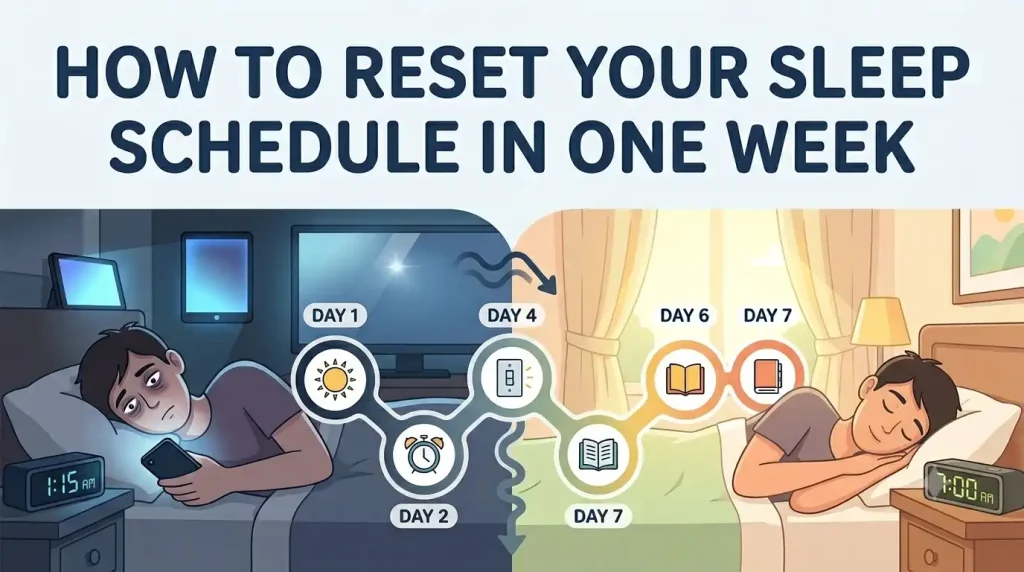
Your 7-Day Sleep Reset Plan
Pick your target bedtime, then walk it back gradually from where you are now. Here’s the shape of the week:
Each night:
Set your bedtime 15–20 minutes earlier than the night before, and set your alarm 15–20 minutes earlier each morning to match. Keep nudging both ends earlier until you hit your target.
Every morning:
Get bright light within 30 minutes of waking step outside, open the curtains, or take a short walk. This is the most powerful lever you have for shifting your clock earlier.
Every evening:
Dim the lights an hour before bed, put screens away, and do something calming. Darkness is what lets melatonin rise on schedule.
Hold the same wake-up time every day including the weekend, which is where most resets quietly fall apart. By night seven, your body has a clear new rhythm to settle into.
The 5 Levers That Make It Stick
The day-by-day shift works best when these habits back it up:
Morning light. Sunlight early in the day anchors your clock earlier and boosts daytime alertness the number-one tool for a reset.
A consistent wake time. Waking at the same time every day, even after a rough night, is what truly locks the rhythm in.
An earlier dinner. Finish eating a couple of hours before bed; late, heavy meals keep your body busy when it should be winding down. Eating breakfast soon after waking helps too.
Daytime movement. Regular exercise helps you fall asleep faster and sleep deeper just keep vigorous workouts a few hours before bedtime.
Calm, dim evenings. Lower the lights, lose the screens, and let your body read the cue that night has arrived.
What About Melatonin, Sleep Aids, and All-Nighters?
When people want to fix their schedule fast, these come up first. A low dose of melatonin taken a few hours before your target bedtime can gently nudge your timing, and it’s especially handy for jet lag but it’s best used short-term, and it’s worth checking with a doctor first, particularly if you take other medications. Pulling an all-nighter to “force” a reset isn’t recommended; it leaves you depleted and rarely sticks. Gentle and gradual wins every time.
Be Patient With the Process
Progress is rarely perfectly neat. You might feel sleepy earlier for two nights, then have one evening where your brain suddenly wants to host a meeting at 11:30pm. That’s not failure it’s your body adjusting unevenly, which is how real change looks. Focus less on hitting an exact bedtime and more on whether your overall pattern is getting steadier. It will.
If your sleep stays stubbornly off after a few weeks of consistent effort, or you’re exhausted despite enough time in bed, check in with a doctor circadian rhythm disorders and conditions like sleep apnea are common and treatable.
The Bottom Line
To reset your sleep schedule in a week: shift your bedtime and wake time 15–20 minutes earlier each day, flood your mornings with light, keep your evenings dim and calm, and protect a consistent wake-up time — weekends included. Steady, gentle nudges are all it takes to get your body clock back on your side.