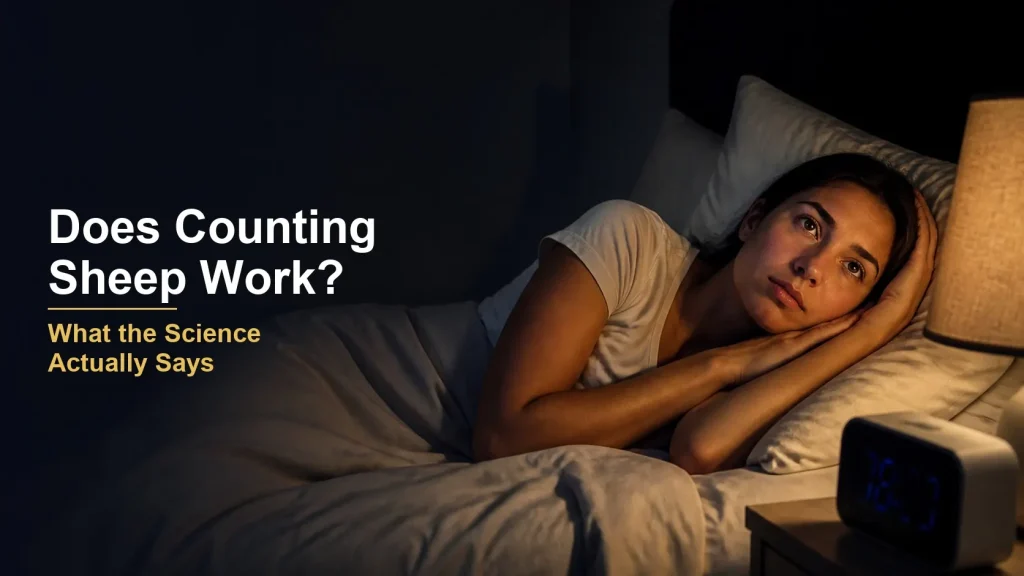
It’s the oldest sleep tip in the book: can’t drift off? Picture a fence and start counting fluffy sheep hopping over it. Generations have tried it — but does counting sheep actually work? Science has genuinely looked into this, and the answer is a bit surprising. Here’s the verdict, plus the mental tricks that work far better.
The Surprising Verdict
Counting sheep probably doesn’t work very well. In a well-known study, Oxford researchers had insomnia sufferers try different mental strategies to fall asleep. The sheep-counters actually took longer to nod off than people who imagined a relaxing scene. So the classic trick, it turns out, is one of the less effective options. For a wider look at the underlying science, see this overview.
Why Counting Sheep Falls Short
The problem is that counting sheep is just too boring and monotonous to fully hold your attention. Because it’s so repetitive and unengaging, your mind quickly gets bored, wanders off, and drifts right back to the worries and to-do lists that were keeping you awake in the first place. To quiet a busy mind, you need something absorbing enough to crowd out anxious thoughts — and endlessly counting identical sheep simply isn’t it.
What Actually Works Better
The researchers found that people who pictured a vivid, relaxing scene — a calm beach, a peaceful forest, a favorite cozy place — fell asleep faster. The key is richness and engagement. Here are the mental tricks worth trying instead:
Immersive visualization. Don’t just picture a beach — be there. Feel the warm sand, hear the waves, smell the salt air. Engaging multiple senses gives your mind a full, calming task that leaves no room for worry.
The cognitive shuffle. Picture a series of random, unrelated objects, one after another — a lamp, a kite, an apple, a river. This gentle randomness mimics the drifting, disconnected thoughts your brain naturally has as it falls asleep, easing you into it.
Slow breathing. Techniques like the 4-7-8 method (inhale 4, hold 7, exhale 8) give your mind a focus and physically calm your nervous system.
A body scan. Slowly move your attention through your body from toes to head, relaxing each part — soothing, absorbing, and sleep-inducing.
The Kernel of Truth
Here’s the thing: counting sheep isn’t a totally silly idea — it’s just a weak version of a good one. The underlying principle is sound: giving your restless mind a gentle, neutral focus really does help distract it from anxious thoughts. Counting sheep just picks a task that’s too dull to do the job. Swap it for something richer and more relaxing, and you’re using the same idea, far more effectively.
The Bottom Line
Does counting sheep work? Not especially — research suggests it’s too monotonous to keep your mind off your worries, and it may even slow you down. But the instinct behind it is right: occupy your mind gently to crowd out racing thoughts. Trade the sheep for a vivid, immersive relaxing scene, the cognitive shuffle, or slow breathing, and you’ll give your brain a genuinely soothing path to sleep.
Related reading: the bedroom setup guide and calmer ways to fall asleep.
Frequently Asked Questions
Does counting sheep actually help you fall asleep?
Not very well. Research found that people counting sheep took longer to fall asleep than those imagining a relaxing scene. It’s too boring and repetitive to hold your attention, so your mind wanders back to worries.
Why doesn’t counting sheep work?
Because it’s monotonous and unengaging. To quiet a busy mind you need a task absorbing enough to crowd out anxious thoughts, and endlessly counting identical sheep is too dull, so your mind drifts back to whatever’s keeping you awake.
What should I think about to fall asleep instead?
Picture a vivid, immersive relaxing scene using all your senses, try the “cognitive shuffle” (imagining random unrelated objects), use slow breathing like the 4-7-8 method, or do a body scan. These occupy and calm your mind far more effectively.
What is the cognitive shuffle?
The cognitive shuffle is imagining a series of random, unconnected objects one after another. This mimics the drifting, disjointed thinking your brain does as it naturally falls asleep, helping distract you from worries and ease you toward sleep.
Is there any truth to counting sheep?
The principle is sound — giving your mind a gentle, neutral focus does help distract from anxious thoughts. Counting sheep just chooses a task too boring to work well. A richer, more relaxing focus uses the same idea much more effectively.

Michael Reeves covers topics related to sleep quality, bedroom comfort, and modern lifestyle habits. He enjoys researching sleep products, recovery routines, and productivity-focused wellness practices to create informative and reader-friendly content. Michael writes about bedroom setup, recovery, and the connection between sleep quality and how you feel during the day.
All guides by Michael ReevesGeneral guidance, not medical advice. If a sleep problem persists or gets worse, speak to a qualified clinician. Medical disclaimer