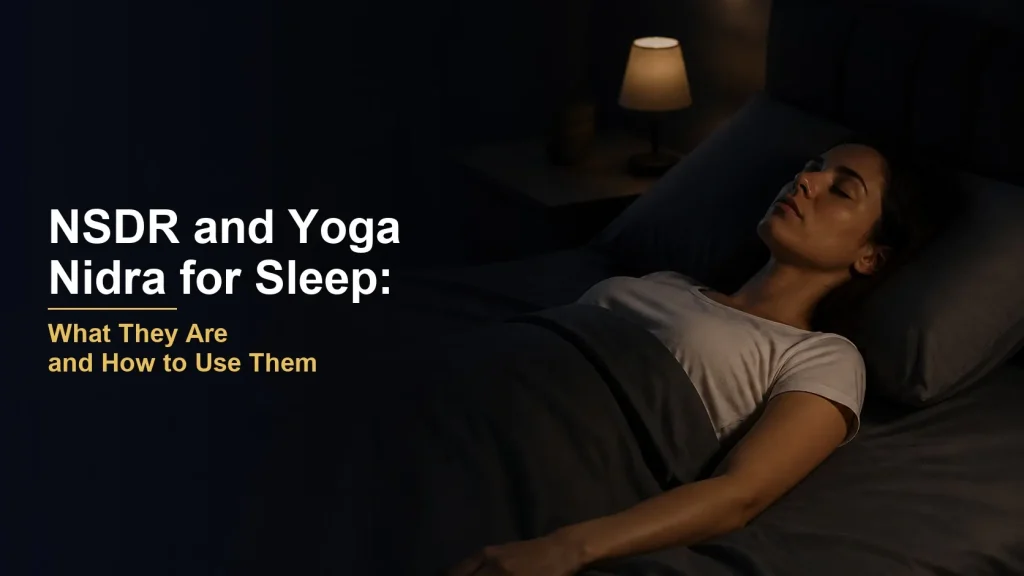
You may have seen “NSDR” popping up everywhere lately — a buzzy term for a deeply restful practice that can calm your mind, restore your energy, and help you sleep. But it’s actually rooted in an ancient technique called yoga nidra. Here’s what NSDR and yoga nidra are, how they help your sleep, and how to try them tonight.
What Is NSDR?
NSDR stands for Non-Sleep Deep Rest — a term popularized to describe practices that guide your body and mind into a state of deep relaxation without actually falling asleep. It’s an umbrella term, and its best-known form is yoga nidra, sometimes called “yogic sleep.” In NSDR, you rest on the edge of sleep — fully relaxed and calm, yet still aware. Think of it as a deliberate, guided way to reach the deeply restorative state your body usually only touches during sleep. For a wider look at the underlying science, see this overview.
What Is Yoga Nidra?
Yoga nidra is a centuries-old guided meditation practiced lying down. A voice leads you through a sequence — typically a body scan (moving your attention slowly through your body), breath awareness, and gentle mental imagery — that steadily deepens your relaxation. Unlike seated meditation, the goal isn’t focus or effort; it’s surrender. You simply lie back, follow the voice, and let your nervous system unwind. Most sessions run 10 to 30 minutes.
How NSDR and Yoga Nidra Help Your Sleep
These practices support sleep in several ways. They activate your relaxation response, lowering heart rate and easing you out of the stress state that keeps you wired. They quiet a racing mind, giving your attention a calm, guided focus instead of anxious spirals. And they help you practice letting go — the exact skill needed to fall asleep. Many people use NSDR to drift off at bedtime, to resettle after waking in the night, or simply to recover energy during the day when they’re running on too little sleep.
While NSDR isn’t a full replacement for actual sleep, it’s genuinely restorative — a way to calm your system and top up your rest when you need it.
How to Try It Tonight
Getting started is simple. Lie down comfortably in bed (or anywhere quiet), dim the lights, and put on a guided NSDR or yoga nidra recording — there are many free ones online and in meditation apps, ranging from about 10 to 30 minutes. Then just follow the voice: relax your body part by part, notice your breath, and let yourself sink toward the edge of sleep. There’s nothing to achieve and no way to do it wrong. If you’re using it to fall asleep, it’s perfectly fine to drift off before the recording ends.
Tips to Get the Most From It
Use a guided audio while you’re learning — the voice does the work so you can fully let go. Practice regularly, since the relaxation gets deeper and easier the more you do it. And release any pressure to “succeed”: the point is to rest, not to perform, so even if your mind wanders, simply returning to the voice is the practice working.
The Bottom Line
NSDR (non-sleep deep rest) and its classic form, yoga nidra, are simple guided practices that bring your body and mind into deep, restorative calm. By activating your relaxation response and quieting mental chatter, they can help you fall asleep, resettle in the night, or recharge during the day. Lie down, follow a guided recording, and let yourself unwind — it’s one of the easiest, most effective additions to a modern wind-down routine.
Related reading: the bedroom setup guide and calmer ways to fall asleep.
Frequently Asked Questions
What is NSDR?
NSDR stands for Non-Sleep Deep Rest, an umbrella term for guided practices that bring you into deep relaxation without falling asleep. Its best-known form is yoga nidra. You rest on the edge of sleep — deeply calm yet aware — which is restorative for body and mind.
What is the difference between NSDR and yoga nidra?
Yoga nidra is a specific, centuries-old guided practice, while NSDR is a modern umbrella term that includes yoga nidra and similar deep-rest techniques. In practice, the terms are often used interchangeably.
Does NSDR help you sleep?
Yes, for many people. It activates the relaxation response, quiets a racing mind, and helps you practice letting go — all of which support falling asleep. People use it at bedtime, to resettle after waking, or to recover energy during the day.
How do I do yoga nidra for sleep?
Lie down comfortably, dim the lights, and follow a guided yoga nidra or NSDR recording (usually 10–30 minutes). Let the voice lead you through a body scan and breath awareness as you relax toward the edge of sleep. It’s fine to drift off before it ends.
Can NSDR replace sleep?
No. NSDR is deeply restful and can help you recover and calm down, but it’s not a substitute for the essential functions of real sleep. Think of it as a helpful supplement to good sleep, not a replacement for it.

Emily Carter writes about sleep routines, nighttime habits, and wellness-focused lifestyle improvements. Her content at The Way We Sleep focuses on practical sleep tips, relaxation methods, and everyday strategies that can help readers create healthier sleep environments. Emily covers nightly routines, relaxation techniques, and the small lifestyle shifts that add up to better rest.
All guides by Emily CarterGeneral guidance, not medical advice. If a sleep problem persists or gets worse, speak to a qualified clinician. Medical disclaimer