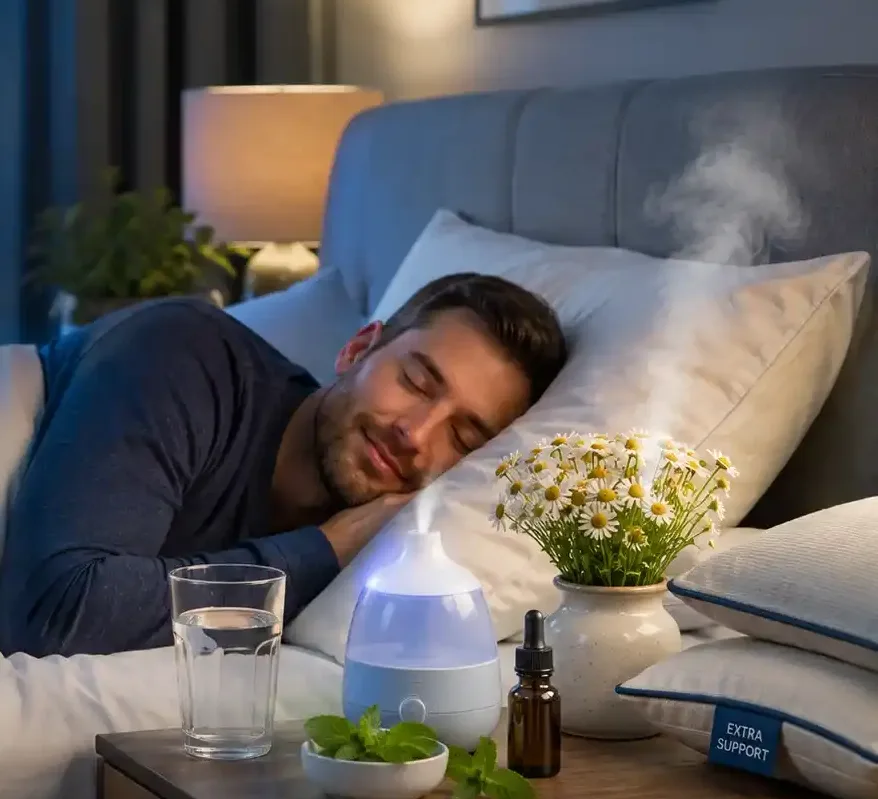
When the heat kicks on for the season, a lot of people start waking up with a scratchy throat, a stuffy nose, or lips that feel like sandpaper. Cold outdoor air holds less moisture, and indoor heating can leave your bedroom feeling even drier. That’s when many people start thinking about sleeping with a humidifier.
A humidifier can make your bedroom more comfortable on dry winter nights, but it only helps if you use it the right way. Too much moisture or a dirty tank can cause new problems. This guide covers the real benefits, the ideal humidity level, which type to choose, and how to keep it clean and safe.
Quick Summary
- Sleeping with a humidifier can ease dry-air discomfort like a dry nose and throat, congestion, cracked lips, and dry skin.
- Aim for indoor humidity between 30% and 50%. A simple hygrometer tells you where your room stands.
- Cool-mist models are the safer choice, especially in kids’ rooms, because hot water and steam can cause burns.
- Place it a few feet from your bed, about six feet if you can, where air circulates.
- Empty and dry it daily, clean it every three days, and use distilled or demineralized water to avoid mold, bacteria, and mineral dust.
Why Dry Air Can Disrupt Your Sleep
According to Mayo Clinic, humidity tends to be higher in summer and lower in winter. Low humidity can dry out your skin, irritate the inside of your nose and throat, and make your eyes feel itchy. Dry indoor air can also lead to bloody noses and cracked lips.
None of that is great when you’re trying to sleep. Cleveland Clinic notes that when your airways are dried out, you’re more likely to snore, and you’re at greater risk of waking up coughing or being disturbed by nosebleeds and dry mouth.

Signs your bedroom air might be too dry
- You wake up with a dry or sore throat
- Your nose feels stuffy, dry, or crusty in the morning
- Your lips are chapped or your skin feels tight and itchy
- You get static shocks around the house
- Nosebleeds show up more often in winter
These signs don’t prove your air is dry, but they’re a good reason to check the humidity level before buying anything.
Benefits of Sleeping With a Humidifier
The Sleep Foundation lists several ways a humidifier can help you sleep more comfortably when the air is dry.
1. Easier breathing during colds
Humidified air can help loosen mucus and may ease a stuffy nose. Mayo Clinic notes that a cool-mist humidifier can ease a stuffy nose during a cold, while heated humidified air doesn’t seem to have the same effect. For more ways to rest when you’re under the weather, see our guide on how to sleep when you’re sick.

2. Less dryness in your nose, throat, and lips
Moisture in the air can help with dry nasal passages, a dry throat, and cracked lips. The Sleep Foundation also notes that dry air can dry out the membranes in your nose and raise the risk of nosebleeds, which a humidifier may help reduce.
3. More comfortable skin and eyes
According to the Sleep Foundation, dry air can reduce skin hydration, and humidified air can help relieve scaly, itchy, or cracked skin. It may also help with dry eyes. If you’re working on your nighttime skin routine, our article on how sleep affects your skin is a good next read.

4. Possibly less snoring
Because dry airways can make snoring more likely, adding moisture may help some people. It won’t fix snoring caused by other issues, though. Our guide to natural snoring remedies covers more options, and loud snoring with gasping or pauses in breathing is worth discussing with a doctor.
5. A gentle background hum
The Sleep Foundation points out that some humidifiers create a steady background noise that can mask other sounds. If you like that effect, you might also enjoy white, pink, or brown noise.
6. Comfort for CPAP users
The Sleep Foundation also notes that humidifiers may help reduce the dryness and congestion that some people get with CPAP therapy. Many CPAP machines have their own built-in humidifier, so ask your sleep doctor before changing your setup.
What Humidity Level Is Best for Sleep?
Mayo Clinic says it’s ideal to keep indoor humidity between 30% and 50%. The U.S. Environmental Protection Agency (EPA) advises against humidifying above 50% relative humidity, since higher levels may encourage the growth of mold and other organisms. MedlinePlus suggests setting a unit to 40% to 50%.
| Humidity level | What it means for your bedroom |
|---|---|
| Below 30% | Air is likely dry. You may notice dry skin, a dry nose and throat, or static. |
| 30% to 50% | The generally recommended range for comfort and health. |
| Above 50% | Too damp. Condensation can form and encourage mold, bacteria, and dust mites. |
How to measure it
The easiest way is a hygrometer, a small and inexpensive device that measures moisture in the air. Mayo Clinic suggests considering a humidifier with a built-in humidistat, which helps keep humidity within a healthy range automatically.
Humidity works hand in hand with temperature. If you haven’t dialed in your thermostat yet, see the best temperature for sleep.
Which Type of Humidifier Is Best for a Bedroom?
Mayo Clinic describes several common types:
- Ultrasonic: uses sound waves to release a cool mist.
- Impeller: uses a rotating disk to give off a cool mist.
- Evaporative: uses a fan to blow air through a wet wick or filter.
- Steam vaporizer: heats water to create steam that cools before it leaves the machine.
- Central: built into your home’s heating and air system to humidify the whole house.
Cool mist vs. warm mist
For most bedrooms, especially kids’ rooms, a cool-mist model is the safer pick. MedlinePlus recommends always using a cool-mist humidifier, especially for children, because warm-mist units can cause burns if someone gets too close. Mayo Clinic also advises against steam vaporizers in homes with children, since the hot water can burn if spilled.
One trade-off to know: Mayo Clinic notes that evaporators and steam vaporizers may be less likely than cool-mist humidifiers to release airborne allergens. That’s one more reason to keep any cool-mist unit very clean.
Skip the essential oils
It’s tempting to add a few drops of lavender, but Mayo Clinic says humidifiers only add moisture to the air and can’t be used to breathe in products like essential oils. It also advises not adding anything to the water unless the manufacturer approves it. If you love scent at bedtime, use a separate diffuser and see our guide to essential oils for sleep.
How to Use a Humidifier Safely While You Sleep
Placement
- Keep some distance. The Sleep Foundation suggests placing your humidifier about six feet from your bed, and MedlinePlus recommends several feet (about 2 meters) away.
- Choose a spot with airflow, such as near a heating vent, rather than a cramped corner.
- Watch nearby surfaces. If windows, carpet, curtains, or bedding start to feel damp, Mayo Clinic advises turning the humidifier down or using it less.
Water
Use distilled or demineralized water. Mayo Clinic explains that tap water contains minerals that can encourage bacteria to grow inside the humidifier and can be released into the air as white dust on your furniture. The EPA adds that distilled water usually contains fewer minerals than most tap water.
How to Clean Your Humidifier
A dirty humidifier is the biggest risk of sleeping with one. Mayo Clinic warns that dirty tanks and filters can grow bacteria and mold, and releasing them into the air may trigger flu-like symptoms or even lung illness, even in healthy people.
Here’s the routine recommended by Mayo Clinic, the EPA, and the Sleep Foundation:
- Every day: unplug the unit, empty the tank, wipe the inside dry, and refill with fresh water.
- Every three days: unplug it and scrub away any film or mineral buildup. Mayo Clinic suggests a 3% hydrogen peroxide solution, or the cleaner your manufacturer recommends.
- After cleaning: rinse the tank thoroughly so no cleaning chemicals end up in the air.
- Filters: change them at least as often as the manufacturer suggests, and sooner if they look dirty.
- Before storing it for the season: drain and clean it, and clean it again when you take it back out.
If buildup becomes hard or impossible to remove, Mayo Clinic suggests it may be time to replace the humidifier.
While you’re refreshing the bedroom for winter, it’s also a good time to clean your mattress, since excess moisture and dust mites tend to go together.
Who Should Check With a Doctor First?
Mayo Clinic recommends that people with asthma or allergies, and parents of children with these conditions, talk with a healthcare professional before using a humidifier. Mist from a dirty unit can carry bacteria or mold that may trigger or worsen symptoms, and high humidity can encourage mold and dust mites.
Other Ways to Ease Dry Air at Night
No humidifier? Mayo Clinic suggests a few simple alternatives:
- Use a saline nasal spray or rinse for a dry nose. If you rinse, use distilled, sterile, or boiled-and-cooled water, never water straight from the tap.
- Sip warm tea or water and stay hydrated.
- Keep showers short and warm instead of long and hot, and apply moisturizer right after.
- Use lip balm before bed.
For more ways to make your room a better place to sleep, read our guide to creating the perfect sleep environment.
The Bottom Line
Sleeping with a humidifier can make dry winter nights much more comfortable, easing a dry nose and throat, congestion, cracked lips, and dry skin. The keys are keeping humidity between 30% and 50%, choosing a cool-mist model for safety, placing it a few feet from your bed, using distilled water, and cleaning it often. Get those basics right, and a humidifier can be one of the simplest upgrades to your winter sleep setup.
FAQ: Sleeping With a Humidifier
Is it OK to run a humidifier all night?
For many people, yes, as long as the room stays at or below 50% humidity and the unit is clean. A humidistat or hygrometer helps you avoid over-humidifying. If surfaces in the room feel damp, turn it down.
How far should a humidifier be from my bed?
The Sleep Foundation suggests about six feet, and MedlinePlus recommends several feet away. That keeps mist from settling on your bedding and reduces the risk of burns from warm-mist models.
Can I put tap water in my humidifier?
It’s better to use distilled or demineralized water. Tap water minerals can build up in the unit and be released into the air as white dust.
Should I use a humidifier in my baby’s or child’s room?
If you do, choose a cool-mist model to avoid burns from hot water or steam, keep it out of reach, and clean it carefully. If your child has asthma or allergies, check with their pediatrician first.
This article is for general information only and isn’t a substitute for medical advice. If you have asthma, allergies, frequent nosebleeds, or breathing problems at night, talk with a healthcare provider before using a humidifier.
General guidance, not medical advice. If a sleep problem persists or gets worse, speak to a qualified clinician. Medical disclaimer